
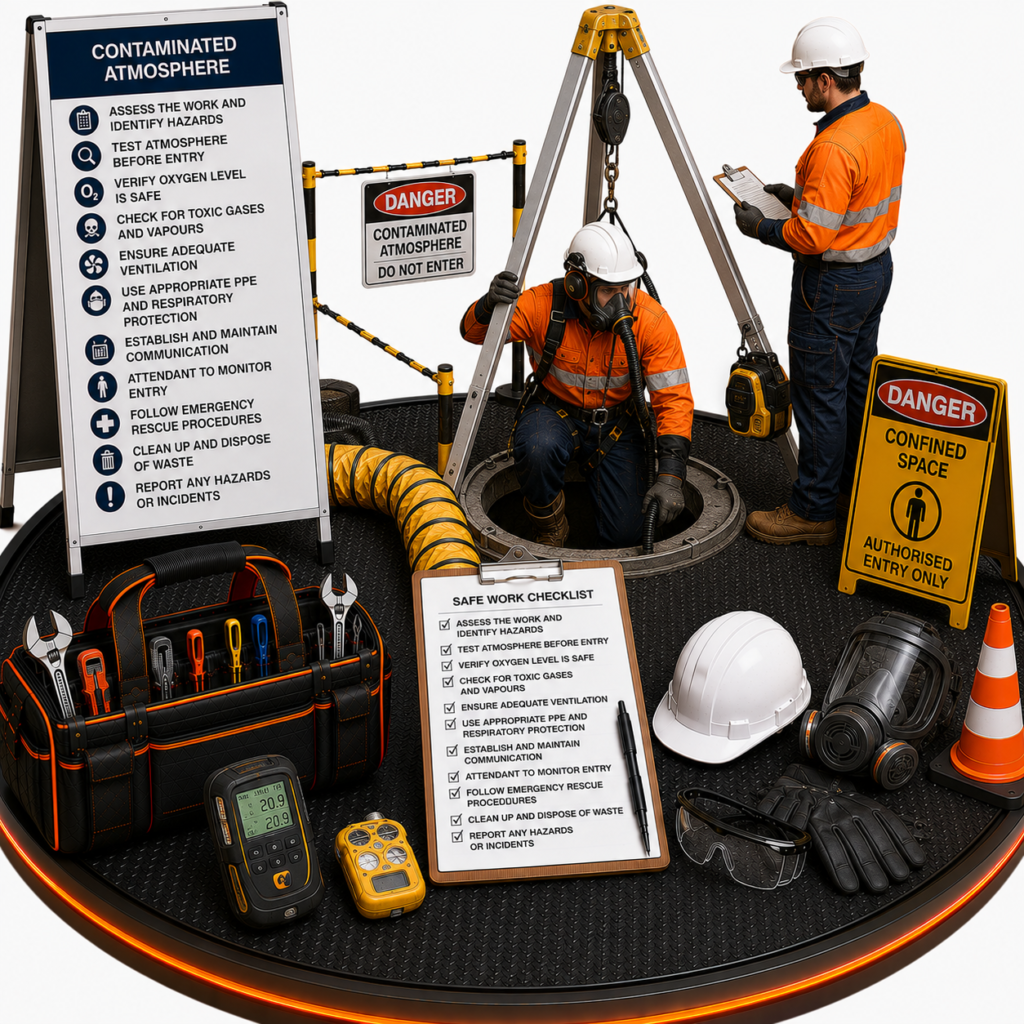
Contaminated Atmosphere SWMS
Professionally Customised for Your Business
- Professionally customised for your business
- Your Logo and Business Details Included
- Editable Microsoft Word (.docx) format
- Compliant with Australian WHS requirements
- Fast turnaround — typically within 1 business day
- Digital access through JobsiteGo (included with purchase total over $797)
$129.00
GST Included
Secure Checkout
100% Australian Owned
24hr Support
Secure Checkout
100% Australian Owned
24hr Support

Australian Compliant
Prepared in accordance with Safe Work guidelines and relevant Australian Standards.
Product Description
Working in areas where airborne contaminants may be present requires careful planning, exposure monitoring and effective control measures to protect workers from hazardous substances. The Contaminated Atmosphere SWMS is intended for demolition contractors, construction businesses and principal contractors undertaking work where exposure to contaminated or potentially contaminated atmospheres may occur. It helps businesses safely plan, manage and document activities involving airborne contaminants while supporting site-specific risk management and compliance with Australian WHS requirements.
Construction and demolition activities can expose workers to a range of hazardous airborne contaminants generated through cutting, drilling, demolition, welding, plant operation and material handling. Without appropriate controls, exposure to respirable dusts, fumes and other airborne hazards can present significant health risks. This SWMS establishes a structured approach to identifying potential atmospheric contaminants, implementing suitable engineering and administrative controls, selecting appropriate respiratory protection and maintaining safe work practices throughout the project.
Rather than focusing on a single work activity, this SWMS supports businesses performing a variety of construction and demolition tasks where hazardous airborne contaminants may be encountered. It provides a practical framework that can be reviewed and customised to suit individual workplaces, environmental conditions and project requirements.
Activities Covered
- Assessing work areas for potential airborne contaminants.
- Planning work involving contaminated or potentially contaminated atmospheres.
- Selecting appropriate respiratory protective equipment (RPE).
- Implementing dust suppression methods.
- Providing local exhaust ventilation where applicable.
- Managing work involving crystalline silica.
- Controlling exposure to lead-containing materials.
- Managing diesel particulate emissions.
- Controlling welding fumes.
- Managing vibration exposure.
- Managing occupational noise exposure.
- Monitoring work areas and maintaining housekeeping.
Hazards Addressed
The documented work activity addresses hazards that may include:
- Crystalline silica exposure.
- Lead exposure.
- Diesel particulate emissions.
- Welding fumes.
- Contaminated or flammable atmospheres.
- Airborne dust.
- Hand-arm and whole-body vibration.
- Occupational noise exceeding exposure standards.
- Respiratory hazards.
- Reduced visibility from airborne contaminants.
Control Measures Included
Depending on the selected work method and project requirements, the SWMS outlines controls such as:
- Respiratory protective equipment selected for the work activity.
- Wet methods and water suppression to minimise airborne dust.
- Local exhaust ventilation where applicable.
- Adequate ventilation in enclosed work areas.
- Engineering controls to reduce hazardous exposures.
- Maintenance of diesel-powered equipment to minimise emissions.
- Job rotation to reduce prolonged exposure.
- Regular inspection and maintenance of equipment.
- Worker training in hazardous substance management and safe work practices.
- Good housekeeping and exposure management procedures.
PPE Requirements
The source document specifies PPE including:
- Hard hat.
- High-visibility clothing.
- Safety footwear.
- Eye protection.
- Dust mask.
- Respirator where applicable.
Additional PPE may be required depending on the contaminants present, exposure levels and project-specific hazards.
Plant and Equipment
Plant and equipment may include:
- Telehandler.
- Local exhaust ventilation equipment.
- Dust suppression systems.
- Respiratory protective equipment.
- Air monitoring equipment where applicable.
Hazardous Chemicals
Where applicable, the work may involve exposure to:
- Crystalline silica.
- Lead and lead-containing materials.
- Diesel particulate.
- Diesel fuel.
- LPG.
- Welding fumes.
- Other airborne contaminants generated by construction or demolition activities.
Hazardous substances should be managed in accordance with Safety Data Sheets, applicable Codes of Practice and project-specific procedures.
Emergency Planning
The SWMS includes emergency response procedures covering medical emergencies, utility strikes, electric shock, fire, explosion and the unexpected discovery of asbestos-containing materials, together with reporting and communication requirements.
What’s Included
This editable Microsoft Word SWMS may include:
- Sequential work activities.
- Hazard identification and exposure controls.
- PPE requirements.
- Plant and equipment guidance.
- Emergency response procedures.
- Worker responsibilities.
- Legislative references.
- Consultation and worker sign-off records.
Who This SWMS Is For
Suitable for:
- Demolition contractors.
- Construction contractors.
- Civil contractors.
- Principal contractors.
- Workers undertaking activities where contaminated atmospheres or hazardous airborne contaminants may be encountered.
Australian WHS Requirements
The source document references applicable Australian WHS legislation together with Codes of Practice and Standards relating to crystalline silica, lead, diesel particulate, welding processes, vibration, occupational noise, hazardous chemicals and respiratory protective equipment. Every SWMS should be reviewed and customised to reflect the actual workplace, contaminants present, work methods and exposure risks before work commences.
Why Choose Tradies Compliance?
Tradies Compliance SWMS documents are developed to help construction businesses implement practical, professional safety documentation for managing hazardous workplace exposures. Delivered in an editable Microsoft Word format, they can be customised to suit individual projects while supporting consistent planning, supervision and safe work practices where contaminated atmospheres may be encountered.
✔ Editable Microsoft Word (.docx)
✔ Professionally customised
✔ Your company logo
✔ Business detail
✔ Unlimited edits
✔ Lifetime updates
✔ Risk assessment
✔ Safe work procedures
✔ PPE requirements
✔ Emergency procedures
✔ Review section
✔ Signature page
Digital Access through JobsiteGo
Businesses spending over $797 annually receive complimentary access to JobsiteGo, allowing your customised SWMS library to be securely stored, managed and accessed online.
Online access
Mobile friendly
Cloud storage
How long does customisation take?
Usually under 24 hours. Provisions can be made if you need them faster.
Can you add our logo?
Yes! At checkout you will have the opportunity to send us your logo.
Is the SWMS editable?
Yes – your SWMS comes in Word format for easy editing.
Can I order multiple SWMS?
Yes. You can order as many SWMS as you require.
Are there discounts for multiple purchases?
Yes. The more you order, the more discount you receive. Discounts are applied at checkout.
Document Type
Safe Work Method Statement
Customisation
Included
Turnaround
Within 1 Business Day
Digital Access
Through JobsiteGo
100% Australian Owned
Proudly supporting Australian businesses and jobs.